
How to Manage Your Hair After Braided: The Ultimate 8-Week Care Guide
The health of your hair isn’t determined when you get in the chair—it’s determined by how to take care of hair after braids once you leave the salon. We see it all the time at Blessing Hair Braiding: a client gets a flawless install, but four weeks later, they aren’t sure how to manage your hair after braided, and their edges start thinning.
Below is the exact 8-week schedule we recommend to our clients to keep their style fresh and, most importantly, how to take them down without losing your edges.
Phase 1: The 8-Week Maintenance Schedule (While Braids Are In)
The key to successful hair maintenance after braids is knowing when to moisturize and when to simply leave your hair alone.
Important Note on Duration: Not all braids last 8 weeks.
- Knotless Braids: 4–6 Weeks Max (Because the base is natural hair, they loosen faster).
- Traditional Box Braids: Up to 8 Weeks.
- Cornrows/Feed-ins: 2–4 Weeks.
- Keep this in mind as you follow the schedule below!
- Weeks 1–3: How to Soothe Freshly Braided hair (Tension Relief)
Your scalp is most sensitive during this time. Do not pull your fresh braids into high buns or tight ponytails yet. Let gravity help them loosen naturally to prevent traction alopecia. If you feel itching, apply a light soothing oil (like Peppermint or Jojoba) to the parts. - Weeks 4–6: The “Refresh” Phase (Hydration)
This is when dryness sets in. Use a water-based braid spray daily because dry hair snaps, while moisturized hair stretches. If you need to wash, use a nozzle bottle to apply diluted shampoo directly to the scalp. Focus on the parts and squeeze—do not scrub vigorously, or you will create frizz.The Nighttime Routine: How to Manage Your Hair After Braided Overnight If you sleep on cotton pillowcases, your braids will frizz instantly. To keep them fresh:
-
Wrap It Up: Always wear a jumbo satin bonnet or silk scarf.
-
Pineapple It: If your braids are long, pile them loosely on top of your head to reduce tension on the back of your neck.
-
- Week 8: The Hard Stop
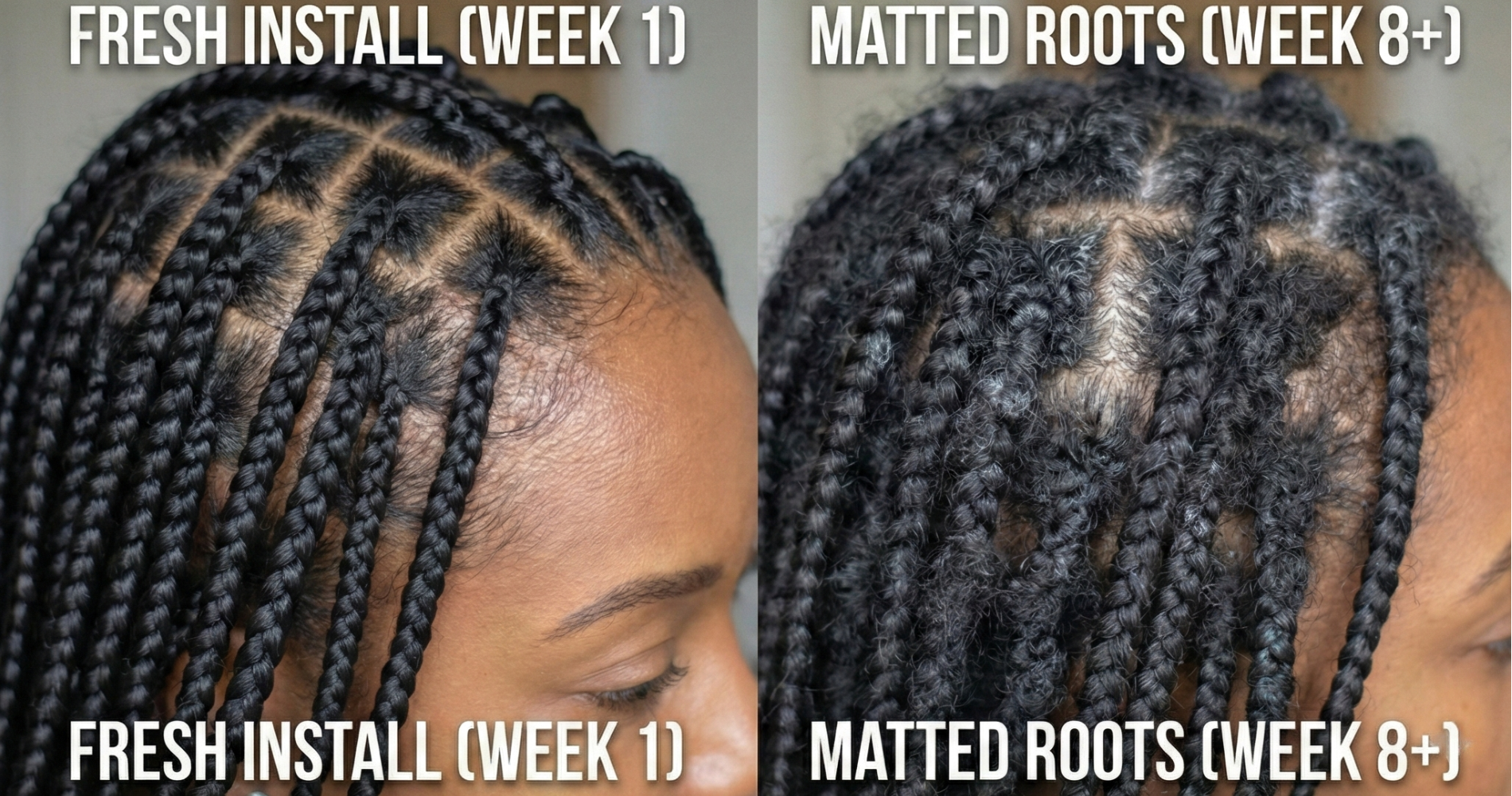
This is the most critical rule: Do not keep braids longer than 8 weeks. Leaving them in too long allows your new growth to twist around the synthetic hair, leading to locking. If you want to avoid severely matted hair, week 8 is your deadline for removal.
What are the signs of unhealthy braids?
If you see these signs, take them down immediately to avoid permanent damage:
-
Heavy Buildup: A thick white ring of dirt at the root.
-
Locking: New growth twisting around the synthetic hair.
-
Thinning Edges: The braid is hanging by a few strands of hair.
Leaving them in past this point guarantees severely matted hair. Week 8 is your deadline.
Phase 2: The Takedown (CRITICAL: Read Before You Unravel)
Many clients ask, “What should I do to my hair after removing braids?” The answer starts before you even touch a bottle of shampoo. If you see a giant clump of hair after braids taken out, do not panic—this is just shed hair that has been trapped for 8 weeks.
Why does hair matted after braids?
It usually happens at the “Line of Demarcation“. This is the sticky spot at the base of your braid where your new growth meets the synthetic hair. It is a mix of dirt, edge control, and sweat.
The Golden Rule: You MUST detangle this buildup with oil or conditioner before wetting the hair. If water touches this buildup while it is dry, it will lock up like a dreadlock instantly.
How to get build up out of Knotless braids
This is the professional secret to removing that buildup without cutting your hair:
- Saturate the buildup spot with a heavy oil (olive oil) or aloe vera gel.
- Massage it with your thumb and index finger until the “gunk” softens.
- Gently pull the strands apart before you even unbraid the hair.
How to detangle synthetic braiding hair (Step-by-Step)
This is critical for how to treat your hair after box braids to ensure you don’t snap your natural ends. Follow this method to separate the synthetic fibre from your natural hair.
- Cut the Excess: Cut the synthetic braid about 2 inches below where your natural hair ends.
- Saturate the Demarcation Line: Apply a product with massive “slip” heavily to the root area.
- Unravel the Braid: Unbraid the synthetic hair all the way up to the root.
- Remove the Synthetic Knot: Gently pull the synthetic hair out. You will be left with a small clump of natural hair that feels “stuck” at the root.
How to detangle 4c hair after braids
Once the synthetic hair is out, follow this specific protocol for 4C textures:
- Finger Detangle Only: Do NOT use a comb yet. Use your fingers to gently pull apart the shed hair at the roots.
- Comb Out: Once the knot is loose, use a wide-tooth comb to smooth it out from ends to roots.
Severely matted hair Nothing Is working
If you neglected the takedown and are now facing a matte that won’t budge, stop immediately.
The Fix: Do not cut it. Saturate the matte in coconut oil or a deep conditioner. Cover your hair with a plastic cap for 1 hour to soften the knot. Then, use the metal end of a rat-tail comb to gently pick the knot apart, strand by strand, starting from the bottom. This is the only safe way regarding how to fix hair matted after braids.
Real Talk: Internet Myths vs. Professional Facts
There is a lot of confusion online about how to manage your hair after braided naturally. We want to set the record straight to save your edges (and your patience).
-
Myth: “You must wash your hair immediately after taking braids out.”
-
The Fact: If your scalp feels tender or sore to the touch, wait 24–48 hours. A raw, sensitive scalp can burn when exposed to clarifying shampoo. Deeply detangle with oil first, let your scalp “breathe” and settle for a day, and then wash.
-
-
Myth: “Apple Cider Vinegar (ACV) is the best natural cleaner.”
-
The Fact: Undiluted vinegar is highly acidic. We see clients frying their low porosity hair by dumping straight vinegar on it. Always dilute it (1 part ACV to 3 parts water) or stick to Aloe Vera gel for a safer, moisturizing detangler.
-
-
Myth: “I can just co-wash (conditioner wash) to get the dirt out.”
-
The Fact: Conditioner cannot remove 8 weeks of edge control and sweat. You must use a clarifying shampoo first. If you co-wash over dirt, you are just sealing the grime into your cuticle.
-
Critical Care Note
The “Scalp Scratch” Danger Zone
The Urge: Everyone wants to scratch their scalp the second the braids come out.
The Risk: Your scalp is currently hypersensitive. Scratching with fingernails creates microscopic cuts. When you apply shampoo later, it will sting and burn intensely.
The Professional Fix: Avoid nails entirely. Use the pads of your fingers or apply a soothing antiseptic oil (like Tea Tree) and massage gently.
Phase 3: The Revival Wash (The “Must-Haves”)
Once the braids are out and detangled, many people ask what should I do to my hair after removing braids? The answer is a hard reset.
The First Wash: Clarifying is Non-Negotiable
Standard moisturizing shampoo won’t cut it. You need to strip 8 weeks of edge control gel and oils.
The Solution: We recommend an Apple Cider Vinegar (ACV) rinse or a strong Clarifying Shampoo. This is how to treat hair after braid removal to ensure your follicles are unclogged and ready to grow.
The Protein vs. Moisture Diagnostic Test
After washing, touch your wet hair. This tells you how to treat your hair after taking out braids:
- If hair feels mushy/gummy: It is weak and needs structure. Use a light Protein Treatment.
- If hair feels hard/brittle (straw-like): It is thirsty. Prioritise Intense Moisture (Deep Conditioning).
Low Porosity Warning: Avoid heavy protein treatments immediately after braids; they can make low porosity hair snap.
The “End Check” (Don’t Skip This)
Even with perfect maintenance, your ends have been rubbing against clothes for 8 weeks.
-
The Test: Look at the bottom inch of your natural hair. If it is see-through or knots easily when you comb it, those are dead ends.
-
The Fix: We recommend a “Dusting” (micro-trim) of 1/4 inch immediately after your revival wash. This stops splits from traveling up the shaft and ruining your length retention.
Phase 4: Deep Conditioning Hacks (Low Porosity Focus)
If you are wondering how to manage braid damage effectively, the secret is heat.
The “Low Porosity” Heat Hack
- The Science: Low porosity hair has tight cuticles that repel water. If you just put cold conditioner on it, the product sits on top.
- The Fix: You must use heat (a steamer, thermal cap, or even a hot towel) to force the moisture into the hair shaft. This turns a regular conditioner into a hydration treatment.
Phase 5: The Resting Phase & Pre-Install Prep
How Long Should You Let Your Hair Rest After Braids?
We know you want to look fly again, but you must rest your scalp.
The Rule: We recommend a 2-week minimum break.
Why? Your scalp needs time to recover from the weight and tension of the extensions. Use these two weeks to do two deep conditioning treatments.
Before Your Next Appointment at Blessing Hair Braiding:
To ensure your next install is itch-free and lasts longer, follow these pre-prep steps 24 hours before you come in:
- Deep Cleanse: Wash your hair thoroughly to remove all old oils.
- Detangle: Please come with your hair detangled. This saves you time and money at the salon.
- No Heavy Grease: Argan oil is fine, but avoid heavy grease before braiding, as it makes the hair slippery and harder to grip.
Book Your Next Install with Blessing Hair Braiding
Now that your natural hair is prepped, rested, and healthy, it is time for your next flawless style! If you are in District Heights, MD, and looking for expert braiders who care about the health of your hair just as much as the look, we are here for you.
Call us today at 301-613-6650 to schedule your appointment!
Frequently Asked Questions (FAQ)
Q: Can you get your hair braided after you dye it?
A: We strongly recommend waiting at least 2 weeks between dyeing and braiding. Chemical dyes (especially bleach) weaken the protein bonds in your hair. Putting immediate tension on freshly dyed hair often leads to severe breakage.
Q: How long should you let your hair rest after braids?
A: You should wait at least 2 weeks before getting your next install. This break allows your scalp tension to subside and gives you time to perform deep conditioning treatments to restore the strength of your hair shaft.
Q: Should I do a protein treatment after braids?
A: It depends on how your hair feels. If your hair feels mushy, gummy, or overly soft when wet, yes—use a light protein treatment to restore structure. However, if your hair feels hard or brittle, avoid protein and focus on intense moisture (deep conditioning) first, as protein can snap dry hair.
Q: How to fix hair matted after braids?
A: Never wash it first! Saturate the matted area with a detangling oil or conditioner to create slip. Use your fingers or the tail of a comb to gently unpick the knot starting from the bottom of the mat, not the top. Patience is key.
Q: How to detangle Black hair after braids?
A: Always detangle on damp (not soaking wet) hair that is saturated with conditioner. Section the hair into 4-8 parts to keep it manageable. Use your fingers to remove the shed hair first, then follow with a wide-tooth comb.
Q: What should I do to my hair after removing braids?
A: Start with a clarifying shampoo to remove product buildup, then follow immediately with a deep conditioner using heat. If your hair feels weak or gummy, follow up with a mild protein treatment to restore strength.
Q: Is it normal to lose a lot of hair after taking out braids?
A: Yes, do not panic! On average, you shed about 100 hairs a day.
-
The Math: If you keep braids in for 8 weeks, that is roughly 5,600 strands of shed hair that had nowhere to go.
-
The Test: Look at a fallen strand.
-
White Bulb at the end? = Natural Shedding (Healthy).
-
Jagged/No Bulb? = Breakage (Needs Protein).
-
Add a Comment